


The IEC 61850 communication protocol standard for electrical substations enables the integration of all protection, control, measurement, and monitoring functions by one common protocol. It provides the means of high-speed substation applications, station wide interlocking and other functions requiring intercommunication between IEDs = blue boxes in the following figure.
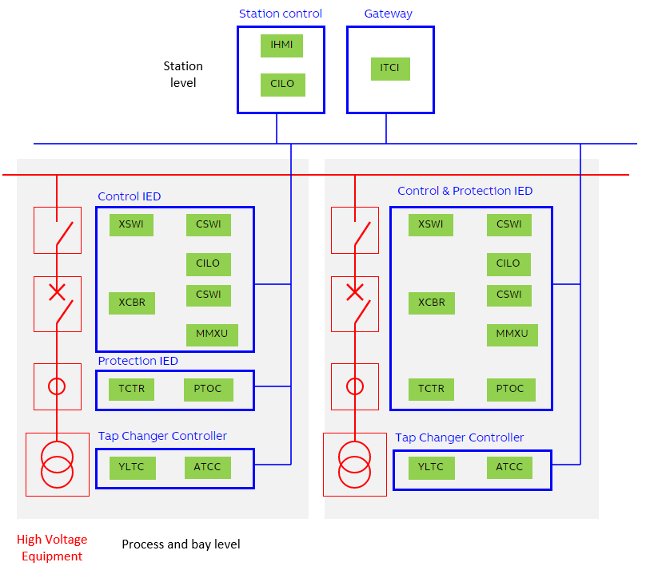
The well described data modelling, the specified communication services for the most recent tasks in a station makes the standard to a key element in modern substation systems.
This manual describes mainly how the IEC 61850 standard is applied in AC500. References and brief descriptions of the IEC 61850 standard are also included in this introduction chapter. Anyhow, it is assumed that the reader has basic knowledge about the IEC 61850.
To understand the IEC 61850 standard and to be able to find the related information, the following parts of the standard are important:
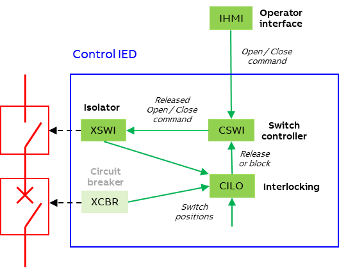
Part 5: Communication requirements for functions and device models
IEC 61850-5 explains how substation functions are realized by logical nodes = function blocks which are running in the IEDs. Operating an isolator from station level for example requires the logical nodes: “IHMI”, “CSWI”, “CILO” and “XSWI”.
Part 7-4: Compatible logical node classes and data classes
The logical nodes and their data objects are defined in IEC 61850-7-4, for example “CSWI”, which is an abbreviation for “Switch controller”.
|
CSWI class |
||
|---|---|---|
|
Data object name |
Common data class |
Explanation |
|
Status information |
||
|
LocKey |
SPS |
Local or remote key |
|
Loc |
SPS |
Local control behavior |
|
OpOpn |
ACT |
Operation "Open switch" |
|
SelOpn |
SPS |
Selection "Close switch" |
|
OpCIs |
ACT |
Operation "Open switch" |
|
SeLCIs |
SPS |
Selection "Close switch" |
|
Controls |
||
|
OpCntRs |
INC |
Resettable operation counter |
|
LocSta |
SPC |
Switching authority at station level |
|
Pos |
DPC |
Switch, general |
|
PosA |
DPC |
Switch L1 |
|
PosB |
DPC |
Switch L2 |
|
PosC |
DPC |
Switch L3 |
Part 7-3: Common data classes
Data objects are based on common data classes, which are defined in IEC 61850-7-3, for example the data object “Pos” (Position) of “CSWI” is based on data class “DPC” (Double Point Controllable).
|
DPC class |
||||
|---|---|---|---|---|
|
Attribute name |
Attribute type |
FC |
TrgOp |
Value / Value range |
|
Control and status |
||||
|
ctlVal |
BOOLEAN |
CO |
off (FALSE), on (TRUE) |
|
|
operTm |
TimeStamp |
CO |
||
|
origin |
Originator |
CO, ST |
||
|
ctlNum |
INT8U |
CO, ST |
0...255 |
|
|
stVal |
CODED ENUM |
ST |
dchg |
Intermediate-state, off, on, bad-state |
|
q |
Quality |
ST |
dchg |
|
|
t |
TimeStamp |
ST |
||
|
stSeld |
BOOLEAN |
ST |
dchg |
|
|
Configuration, description and extension |
||||
|
pulseConfig |
PulseConfig |
CF |
||
|
ctlModel |
CtlModels |
CF |
||
|
sboTimeout |
INT32U |
CF |
||
|
sboClass |
SboClasses |
CF |
||
|
d |
VISIBLE STRING255 |
DC |
Text |
|
|
dU |
UNICODE STRING255 |
DC |
||
Data attributes can be addressed by their full path, for example “CSWI.Pos.stVal” contains the switch status of a certain isolator and can have the values: on, intermediate-state or off (bad-state only in case of defect auxiliary switches).
Part 7-2: Abstract Communication Service Interface (ACSI)
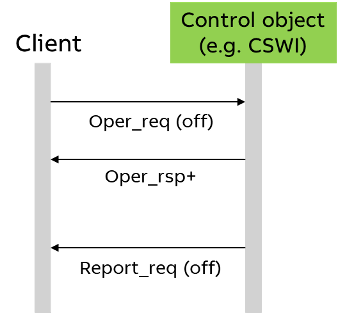
Abstract communication services between logical nodes are described in IEC 61850-7-2. Following figure shows how a client (e.g. “IHMI”) sends an operate command (“Oper_req”) to a control object (e.g. “CSWI”). The control objects sends a confirmation (“Oper_rsp”) immediately and a report with the updated status (“Report_req”) after the “CSWI.Pos.stVal” has changed to off.
Another service is GOOSE (Generic Object Oriented Substation Event), which is used for fast communication like tripping a circuit breaker or interlocking. GOOSE messages are always retransmitted. Slowly in stable conditions and fast after an event has occurred.

T0
Retransmission in stable conditions (no event for a long time).
(T0)
Retransmission in stable conditions may be shortened by an event.
T1
Shortest retransmission time after the event.
T2, T3
Retransmission times until achieving the stable conditions time.
Part 8-1: Specific Communication Service Mapping (SCSM)
Communication profile (IEC 61850 stack) is described in IEC 61850-8-1. This part of the standard maps the abstract services from IEC 61850-7-2 to concrete communication profiles: While core ASCI services like control and reporting are using MMS and TCP/IP, the fast GOOSE service is working directly on the Ethernet layer.
|
|
|
IEC 61850-7-2 |
|
|
|
Client/server |
GOOSE |
|
|
Application |
MMS (ISO 9506) |
|
|
|
Presentation |
ASN.1 |
||
|
Session |
Session |
||
|
Transport |
TCP |
||
|
Network |
IP |
Ethertype |
|
|
Data Link |
Ethernet |
||
|
Physical |
Physical |
||
Part 6: Configuration description language
SCL (Substation Configuration Language) is described in IEC 61850-6. The SCL is an XML based definition of how to describe substation single line, IEDs with logical nodes and their communication through a communication bus.
The following types of SCL files are distinguished:
-
SSD (System Specification Description), describing the single line and required logical nodes.
-
ICD (IED Capability Description), containing the capability (possible logical nodes) of one IED type.
-
CID (Configured IED Description), containing the configuration of a concrete IED with instantiated logical nodes, services and communication addresses.
-
SCD (Substation Configuration Description), containing description of the complete substation, consisting of single line, communication bus and IEDs with logical nodes, which are linked to the primary equipment in the substation section.
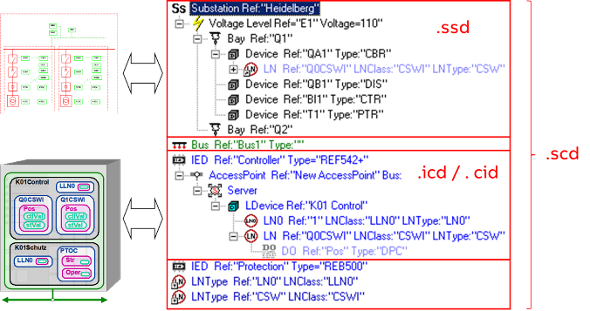
The part IEC 61850-6 also includes the roles of different tools as well as the engineering concepts. It distinguishes between system wide engineering with a system configurator and IED specific engineering with an IED Configurator.
Part 10: Conformance testing
Conformance tests and the basis for conformance documents are handled in IEC 61850-10.
Abbreviations
Short list of IEC 61850 related abbreviations.
|
ASCI |
Abstract Common Services Interface |
|
CID |
SCL type: Configured IED Description |
|
CILO |
Logical node in Group "C -Control functions": Interlocking |
|
CSWI |
Logical node in Group "C - Control functions": Switch Controller |
|
DPC |
Common data class “controllable double point” |
|
GOOSE |
Generic object oriented substation event |
|
ICD |
SCL type: IED Capability Description |
|
IED |
Intelligent Electronic Device (e.g. control or protection relay, AC500, ...) |
|
IHMI |
Logical node in Group "I - Interface and archiving": Generic human – machine interface |
|
MICS |
Modeling Information Conformance Statement |
|
MMS |
Manufacturing Message Specification, ISO 9506 |
|
PICS |
Protocol Information Conformance Statement |
|
PIXIT |
Protocol Extra Information |
|
Pos |
Position of a switch or circuit breaker |
|
SCD |
SCL type: Substation Configuration Description |
|
SCL |
Substation Configuration Language |
|
SSD |
SCL type: System Specification Description |
|
stVal |
Status Value |
|
TCP/IP |
Transmission Control Protocol / Internet Protocol |
|
TICS |
Tissue Information Conformance Statement |
|
XSWI |
Logical node in Group "X - Switchgear": Switch, disconnector or earth-switch |
Further abbreviations can be found in the standard:
IEC 61850-2: Glossary – Terms and definitions, abbreviations
IEC 61850-7-3: List of all Common data classes, like DPC
IEC 61850-7-4: List of all Logical nodes, like CSWI