


For a detailed description of the mounting, disassembly and connection of the module, please refer to the ⮫ installation instructions.
If the output is configured as not used, the voltage and current output signals are undefined and must not be connected.
The connection is carried out by using a removable 9-pin and 11-pin terminal block. These terminal blocks differ in their connection system (spring terminals or screw terminals, cable mounting from the front or from the side). The terminal blocks are not included in the module's scope of delivery and must be ordered separately.
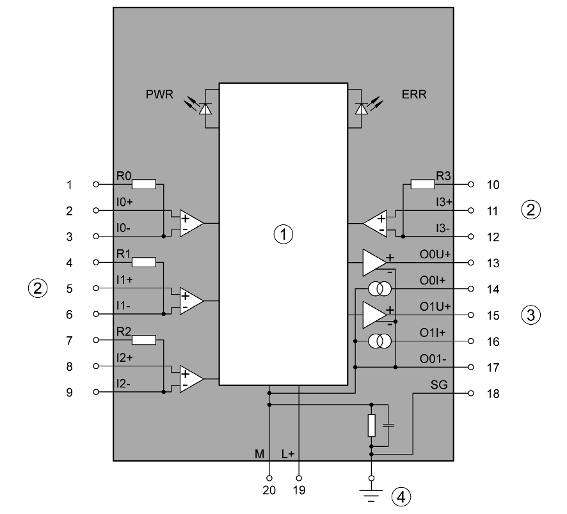
1
Logic - I/O interface
2
Analog inputs
3
Analog outputs
4
Functional earth connection
|
Terminal |
Signal |
Description |
|---|---|---|
|
1 |
R0 |
Burden resistor for input signal 0 for current sensing |
|
2 |
I0+ |
Positive pole of input signal 0 |
|
3 |
I0- |
Negative pole of input signal 0 |
|
4 |
R1 |
Burden resistor for input signal 1 for current sensing |
|
5 |
I1+ |
Positive pole of input signal 1 |
|
6 |
I1- |
Negative pole of input signal 1 |
|
7 |
R2 |
Burden resistor for input signal 2 for current sensing |
|
8 |
I2+ |
Positive pole of input signal 2 |
|
9 |
I2- |
Negative pole of input signal 2 |
|
10 |
R3 |
Burden resistor for input signal 3 for current sensing |
|
11 |
I3+ |
Positive pole of input signal 3 |
|
12 |
I3- |
Negative pole of input signal 3 |
|
13 |
O0U+ |
Voltage output of channel 0 |
|
14 |
O0I+ |
Current output of channel 0 |
|
15 |
O1U+ |
Voltage output of channel 1 |
|
16 |
O1I+ |
Current output of channel 1 |
|
17 |
O01- |
Negative pole of channels O0 and O1 |
|
18 |
SG |
Shield grounding |
|
19 |
L+ |
Process voltage L+ (24 V DC) |
|
20 |
M |
Process voltage M (0 V DC) |
The internal power supply voltage for the module's circuitry is carried out via the I/O bus (provided by a communication interface module or a CPU). Thus, the current consumption from 24 V DC power supply at the terminals UP/L+ and ZP/M of the CPU/communication interface module increases by 5 mA per AX561.
The external power supply connection is carried out via the L+ (+24 V DC) and the M (0 V DC) terminals. The M terminal is interconnected to the M/ZP terminal of the CPU/communication interface module.

NOTICE
Risk of imprecise and faulty measurements!
Analog signals may be severely distorted due to external electromagnetic interference.
When the length of the connection cable exceeds 20 m, a shielded and grounded cable must be used. When the shield is grounded at both ends, an independent low-impedance equipotential connection should be provided to avoid high potential differences between interconnected devices.

WARNING
Removal/Insertion under power
The devices are not designed for removal or insertion under power. Because of unforeseeable consequences, it is not allowed to plug or unplug devices with the power being ON.
Make sure that all voltage sources (supply and process voltage) are switched off before doing the following:
-
Connect or disconnect any signal or terminal block.
-
Remove, mount or replace a module.
Disconnecting any powered devices while energized in a hazardous location could result in an electric arc, which could create a flammable ignition resulting in fire or explosion.
Make sure that power is removed and that the area has been thoroughly checked to ensure that flammable materials are not present prior to proceeding.
The devices must not be opened when in operation. The same applies to the network interfaces.
NOTICE
Risk of damaging the PLC modules!
Overvoltages and short circuits might damage the PLC modules.
-
Make sure that all voltage sources (supply voltage and process supply voltage) are switched off before you begin with operations on the system.
-
Never connect any voltages or signals to reserved terminals (marked with ---). Reserved terminals may carry internal voltages.
The module provides several diagnosis functions.

CAUTION
Risk of damaging the analog input!
The 250 W input resistor can be damaged by overcurrent.
Make sure that the current through the resistor never exceeds 30 mA.
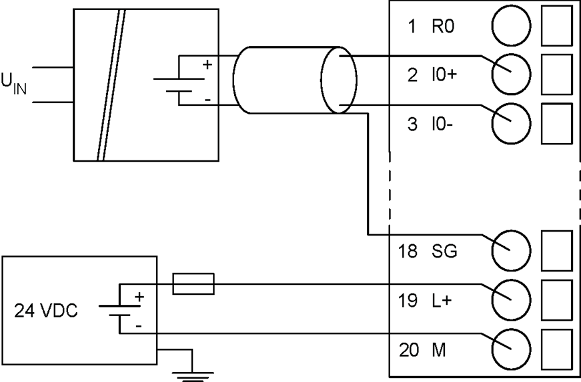
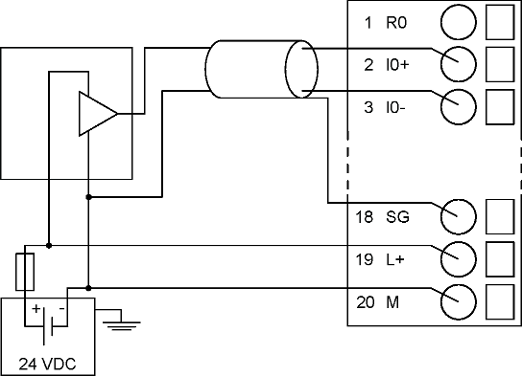
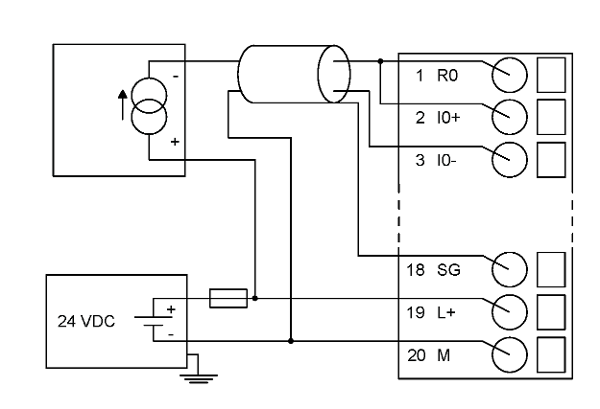
The following figures are an example of the connection of analog sensors (voltage) to the input I0 of the analog input/output module AX561. Proceed with the inputs I1 ... I3 in the same way.
 |
 |
|
Connection of active-type analog sensors (voltage) |
Connection of passive-type analog sensors (voltage) |
|
Connection of active-type analog sensors (voltage) |
Connection of passive-type analog sensors (voltage) |
|---|---|
|
-2.5 V ... 2.5 V |
-2.5 V ... 2.5 V |
|
-5 V ... 5 V |
-5 V ... 5 V |
|
0 V ... 5 V |
0 V ... 5 V |
|
0 V ... 10 V |
0 V ... 10 V |
 |
 |
|
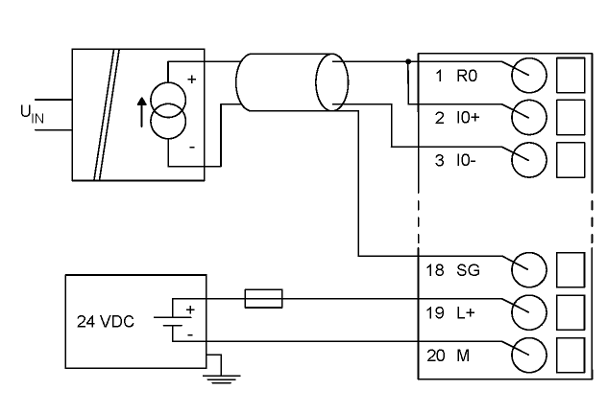
Connection of active-type analog sensors (current) |
Connection of passive-type analog sensors (current) |
|
Connection of active-type analog sensors (voltage) |
Connection of passive-type analog sensors (voltage) |
|---|---|
|
4 mA ... 20 mA |
4 mA ... 20 mA |
|
0 mA ... 20 mA |
 |
 |
|
Connection of analog voltage actuators |
Connection of analog current actuators |
The output signal is undefined if the supply voltage at the L+ terminal is below 10 V. This can, for example, occur if the supply voltage has a slow ramp-up / ramp-down behavior and must be foreseen when planning the installation.
If the output is configured in current mode, the voltage output signal is undefined and must not be connected.
If the output is configured in voltage mode, the current output signal is undefined and must not be connected.