


A VAR_IN_OUT variable is an input/output variable, which is part of a POU interface and serves
as a formal pass-by-reference parameter.
Syntax
<keyword> <POU name>
VAR_IN_OUT
    <variable name> : <data type>;
END_VAR

<keyword> : FUNCTION | FUNCTION_BLOCK | METHOD | PRG
You can declare an input/output variable in the VAR_IN_OUT declaration section in the POUs PRG, FUNCTION_BLOCK, METHOD or FUNCTION. The VAR_IN_OUT variable can be read and written.
Usage
-
Call: When a POU is called, the formal
VAR_IN_OUTvariable receives the actual variable ("pass-by-reference variable") as the argument. At runtime, no copies are generated when parameters are passed. Instead, the formal variable receives a reference to the actual variable passed remotely. The referential variables contain a memory address internally as a value to the actual value (pass as pointer, call-by reference). It is not possible to specify a constant (literal) or a bit variable directly as an argument. -
Read/write access within the POU: If the variable is written to within the POU, then this affects the passed variable. When the POU is exited, any performed changes are retained. This means that a POU uses its
VAR_IN_OUTvariables just like the calling POU uses its variables. Read access is always permitted. -
Read/write access remotely:
VAR_IN_OUTvariables cannot be directly read or written remotely via<function block instance name>.<variable name>. This works only forVAR_INPUTandVAR_OUTPUTvariables. -
Passing string variables: If a string variable is passed as an argument, then the actual variable and the formal variable should have the same length. Otherwise the passed string can be manipulated unintentionally. This problem does not occur in the case of
VAR_OUTPUT CONSTANTparameters. -
Passing bit variables: A bit variable cannot be passed directly to a
VAR_IN_OUTvariable because it needs an intermediate variable. -
Passing of properties: Not permitted
If a string is passed as a variable or a constant to a formal VAR_IN_OUT CONSTANT variable, then the string is automatically passed completely. You do not have to
check the string length.
For more information, see: "VAR_IN_OUT CONSTANT" Transfer Variable
Example
Passing arrays
TYPE DUT_A :
STRUCT
        xA: BOOL;
        iB: INT;
END_STRUCT
END_TYPE

FUNCTION_BLOCK FB_SetArray
VAR_IN_OUT
        aData_A : ARRAY[0..1] OF DUT_A; // Formal variable
END_VAR
aData_A[0].xA := TRUE;
aData_A[0].iB := 100;

PROGRAM PLC_PRG
VAR
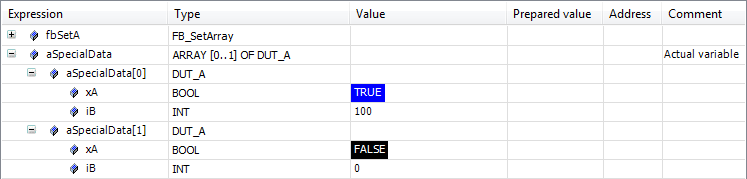
        fbSetA : FB_SetArray;
        aSpecialData : ARRAY[0..1] OF DUT_A; // Actual variable
END_VAR
fbSetA(aData_A := aSpecialData);
Passing strings
{attribute 'qualified_only'}
VAR_GLOBAL
        g_sDEV_STATUS : STRING(25) := 'Device_A';
END_VAR

FUNCTION_BLOCK FB_SetStatus
VAR_IN_OUT
        sDeviceStatus : STRING(25); // Formal parameter
END_VAR
sDeviceStatus := CONCAT(sDeviceStatus, ' Activ');

PROGRAM PLC_PRG
VAR
        fbDoB : FB_SetStatus;
END_VAR
fbDoB(sDeviceStatus := GVL.g_sDEV_STATUS); //Call with actual parameter
The variable sDeviceStatus is part of the POU interface of FB_B. When calling fbDoB, first a device name is assigned to the string and then the string is manipulated.

Passing bit variables
VAR_GLOBAL
        xBit0 AT %MX0.1 : BOOL;
        xTemp : BOOL;
END_VAR

FUNCTION_BLOCK FB_DoSomething
VAR_INPUT
        xIn : BOOL;
END_VAR
VAR_IN_OUT
        xInOut : BOOL;
END_VAR
IF xIn THEN
        xInOut := TRUE;
END_IF

PROGRAM PLC_PRG
VAR
        xIn : BOOL;
        DoSomething_1  : FB_DoSomething;
        DoSomething_2  : FB_DoSomething;
END_VAR

// The following line of code causes a compiler error:
// C0201: Typ 'BIT' is not equal to type 'BOOL' of VAR_IN_OUT 'xInOut'
DoSomething_1(xIn := xIn, xInOut := xBit0);

// Workaround
xTemp := xBit0;
DoSomething_2(xIn := xIn, xInOut := xTemp);
xBit0 := xTemp;
The program calls the function block instances DoSomething_1 and DoSomething_2. As a result of the direct assignment of the bit variable xBit0 to the VAR_IN_OUT input, a compiler error is generated when the DoSomething_1 instance is called. In contrast, calling the DoSomething_2 instance with the assignment of an intermediate variable is correct code.